Our product
What’s ERW Steel Pipe?
Our main products include 1/2 inch to 16 inch ERW PIPE, which has been produced according to BS1387/ASTM A53/EN10255/EN10217 Standard.
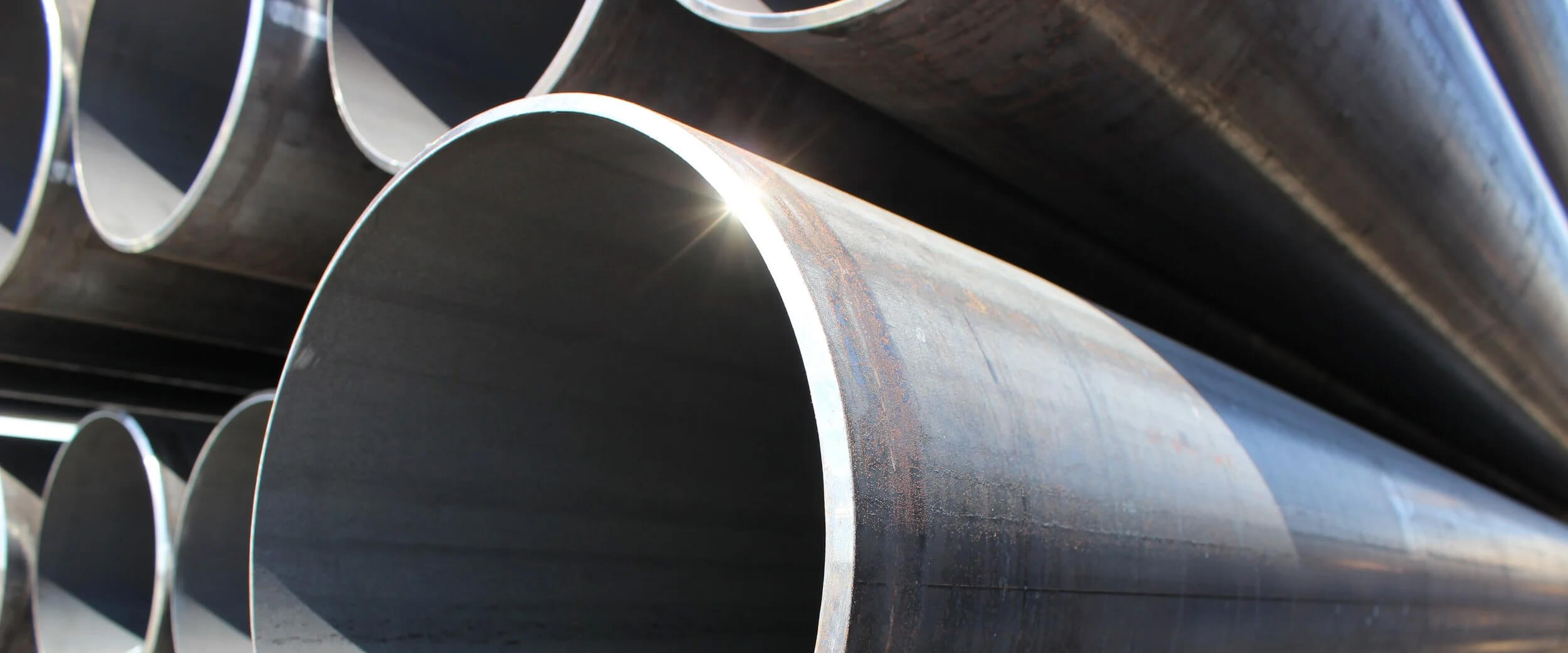
ERW Steel Pipe stands for Electric Resistance Welded pipe. It is manufactured by cold-forming a sheet of steel (derived from a continuous coil) into a cylindrical shape. Unlike other welding methods that use a filler metal (like a welding rod), ERW pipes use the inherent electrical resistance of the steel itself to generate heat.
High-frequency electrical current is passed through the edges of the steel, melting them just enough so that when they are pressed together by rollers, they fuse into a permanent, high-strength bond. Because no foreign metal is added, the chemical composition of the weld is identical to the base steel.
Types of ERW Steel Pipes
We categorize ERW pipes based on their technical application and surface finish:
- High-Frequency Welded (HFW): The modern industry standard. It uses high-frequency current (usually 450 kHz) to ensure a deeper, more consistent weld.
- Black ERW Pipe: Untreated steel pipe, often used for mechanical applications or as a base for custom coatings.
- Galvanized ERW Pipe: Pre-galvanized or hot-dipped to provide a protective zinc layer, making it ideal for water transport and outdoor fencing.
- Line Pipe & Casing: Specialized ERW pipes produced to API standards for the oil and gas industry.
Advantages of Using ERW Steel Pipe
ERW pipes are the most widely used steel pipes globally for a reason:
- High Dimensional Accuracy: Because they are made from high-precision steel coils, ERW pipes have very tight tolerances regarding wall thickness and roundness.
- Cost Efficiency: The continuous manufacturing process is faster and requires less labor than SAW welding, making it the most economical choice for small to medium diameters.
- Weld Integrity: Since no filler metal is used, there is no risk of “weld metal” contamination, resulting in a cleaner, more uniform molecular structure across the seam.
- Smooth Surface: ERW pipes have a very smooth internal and external finish, which is excellent for fluid dynamics and powder coating.
Specifications of ERW Steel Pipes
We produce ERW pipes tailored to various international engineering standards. The following are just a few of the sizes we produce. For a complete list of standards, please visit our product and standards pages, or email us for inquiries.
| Content | Classification | Parameters |
| Definition | Manufacturing Process | High-frequency resistance welding (50-450kHz) |
| Definition | Main Standards | API 5L, EN10219, ASTM A53 |
| Dimension | Diameter Range | 6mm-660mm (1/4″-26″) |
| Dimension | Wall Thickness | SCH10-SCH160 |
| Dimension | Length | 5-14m (customizable up to 12m for ocean freight) |
| Dimension | Tolerances | ±10% (routine), ±5% (precision) |
| Material | Carbon Steel | 10#-45#, Q195-Q345, 16Mn |
| Material | Stainless Steel | GB/T14976-2012 (additional weld testing required) |
| Performance | Yield Strength | 235MPa to 555MPa |
| Testing | Weld Inspection | Ultrasonic flaw detection |
| Testing | Heat Treatment | In-line annealing, hardness ≤ HRB 90 |
ERW pipes are manufactured in strict accordance with standard size requirements, with precise control over inner diameter, outer diameter, length, and wall thickness. Based on diameter, ERW pipes are classified as small diameter (6 mm to 102 mm), medium diameter (114 mm to 508 mm), and large diameter (over 508 mm). Standard lengths typically range from 6 meters to 12 meters. In addition, we offer flexible size customization services to ensure the steel pipe perfectly matches your engineering requirements.
- Outer Diameter (OD): 1/2 inch (12.7 mm) to 24 inches (610 mm)
- Wall Thickness: 0.5 mm to 20 mm, in compliance with international and regional standards
- Tolerances: Strictly controlled in accordance with international and industry standards (e.g., API, ASTM)
All dimensional parameters, including length and wall thickness, are rigorously maintained within specified limits and adhere to international standards, ensuring enhanced durability and long service life. For any needs or inquiries, please feel free to contact us!
ERW Manufacturing Process
Our production line utilizes an automated, continuous process to ensure maximum consistency:
- Slitting: Large steel coils are slit into specific widths based on the desired pipe diameter.
- Uncoiling & Leveling: The steel strip is unwound and flattened to remove any coil set.
- Cold Forming: The strip passes through a series of rollers that gradually curve the flat steel into a circular “open” tube.
- High-Frequency Welding: Induction coils or contact shoes transmit high-frequency current to the strip edges. The edges reach welding temperature and are squeezed together by “squeeze rollers” to create the forge weld.
- De-beading (Scarfing): The excess metal (flash) pushed out during the welding process is trimmed off both the inside and outside of the pipe to create a smooth surface.
- Seam Annealing (Heat Treatment): To ensure the weld area is just as strong and flexible as the rest of the pipe, the weld seam undergoes localized heat treatment.
- Sizing & Cutting: The pipe passes through sizing rollers to achieve the final diameter before being cut to length by a flying saw.